Defensible to your dean
Built on the frameworks your syllabus already cites — Goleman, Tuckman, Thomas-Kilmann, Kolb — and backed by our own outcome data, published with denominators and limits attached.
For MBA & leadership faculty
Students practice leading a real meeting, and are scored on what they do in it — not on text they could have generated.
Students score higher after the debrief than before it in 62% of graded reflections. Method and limits on the research page.

In continuous academic use across
The research page shows the working behind this number — the sample, the effect size, and what a single-group before-and-after can and cannot show.
The same three objections come up in every adoption meeting. Here is how each one is answered before you walk in.
Built on the frameworks your syllabus already cites — Goleman, Tuckman, Thomas-Kilmann, Kolb — and backed by our own outcome data, published with denominators and limits attached.
Consistent, scoreable, replayable practice at any class size, with no grading burden. Live role-play doesn't scale past a dozen students. An LLM chat scales but can't be verified. This does both.
What gets assessed is the student's behavior inside the meeting. No prompt produces the artifact for them. The score still means something in 2026.
The simulation is the loop you already teach — experience, reflect, conceptualize, experiment — made repeatable and gradeable.
The student sits in a live business meeting. NPCs talk; the student chooses what to say, to whom, and when to stay silent.
A graded reflection asks the student to name what actually shifted in the room — power, tension, who backed whose idea.
A scenario-specific debrief connects the moment to the theory: which style they used, which conflict mode, and what it cost them.
The student replays the same scenario — same setup, same colleagues, same fixed rules — and tests a different approach against the same conditions.
Three frames from a single round: the room as the student finds it, and the two ways they are allowed to act on it.

Twelve rounds, four colleagues, and a decision nobody agrees on yet. Ideas wait on the rail at the left; the ones already on the table carry the support they have earned so far.
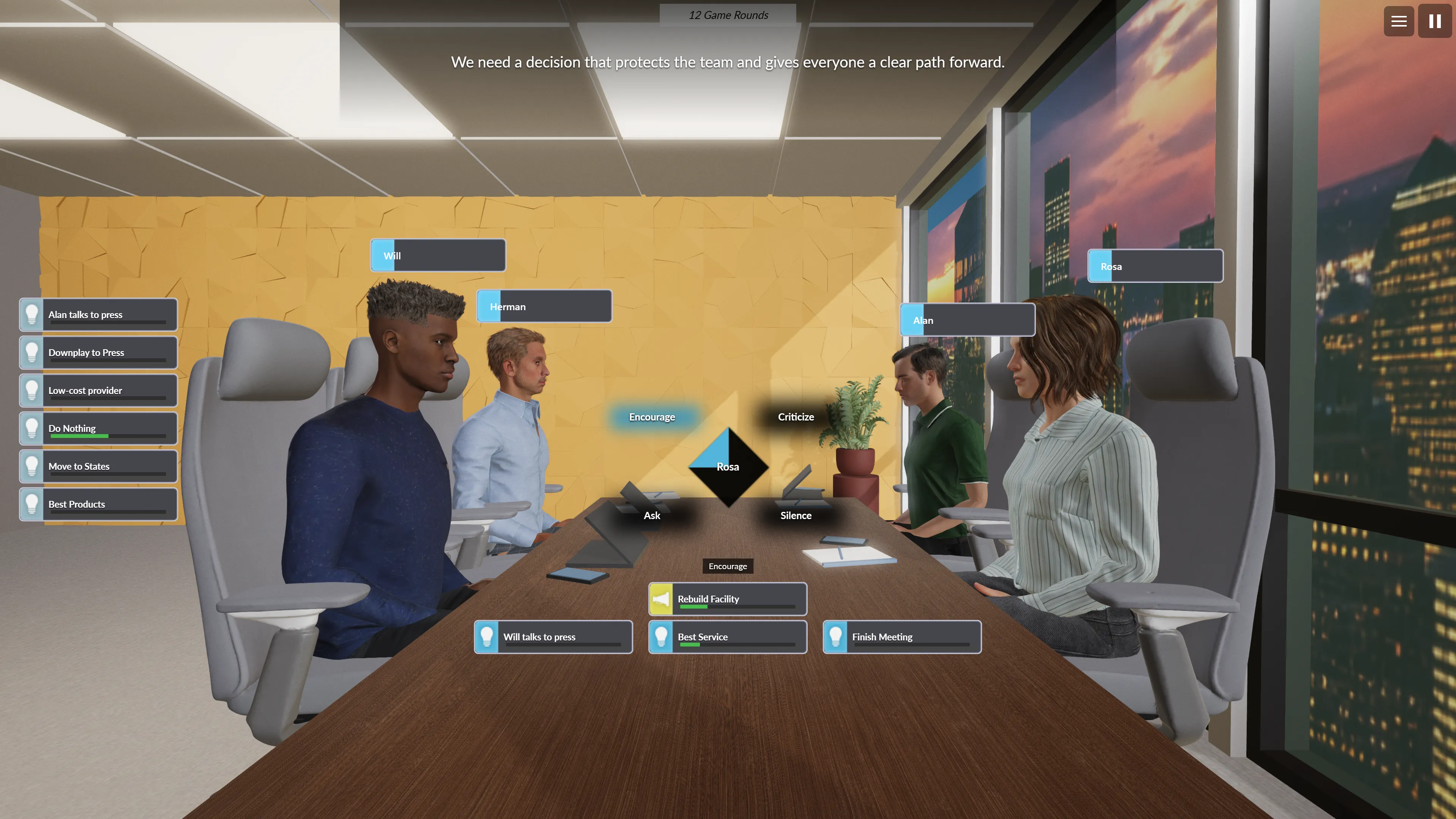
Every move is one of a few named choices, aimed at a person. Here the student encourages Rosa. The meeting has no text box anywhere in it for a prompt to fill.
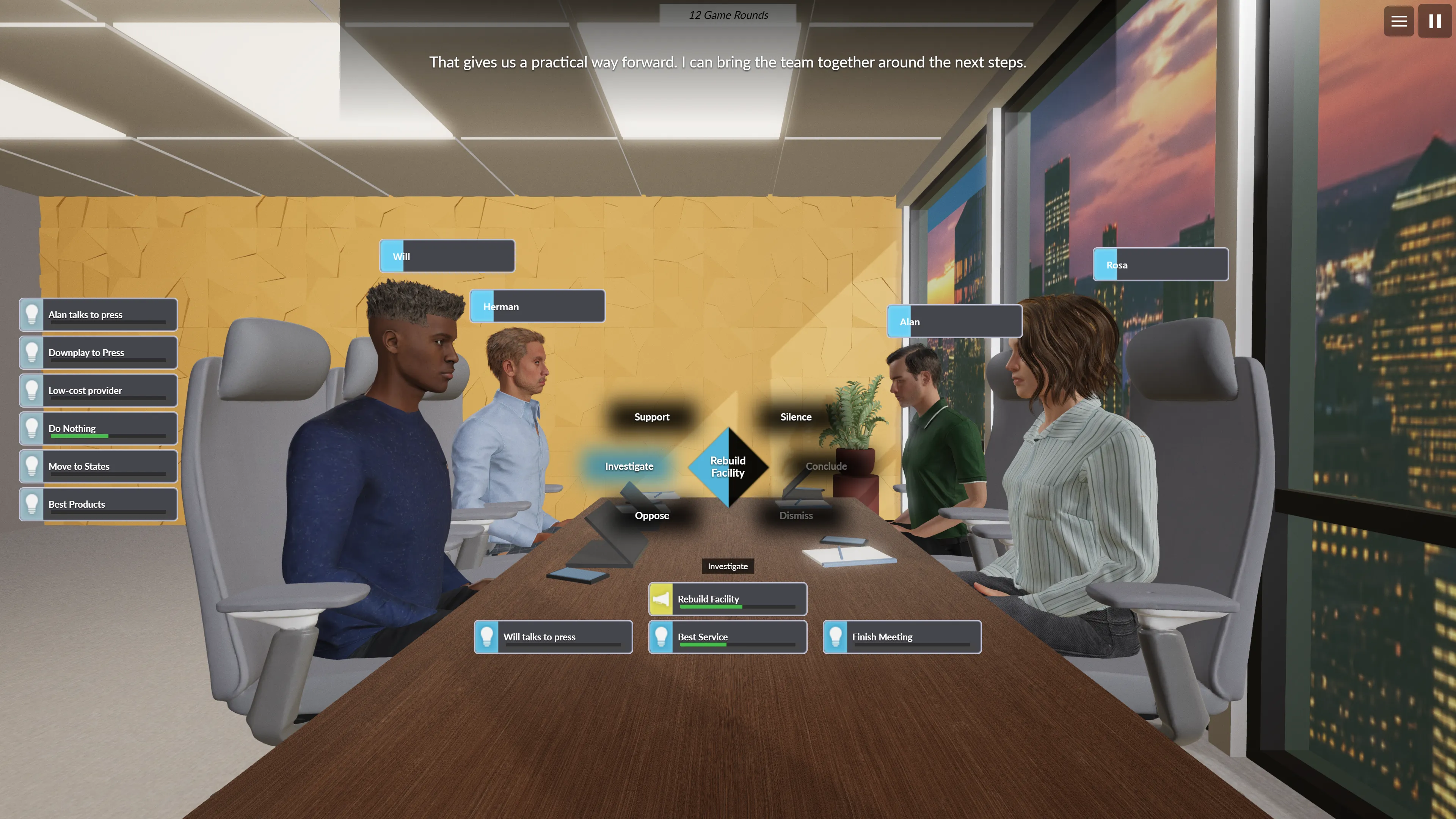
Aimed at an idea rather than a colleague, the choices become Support, Oppose, Investigate or Silence. Conclude and Dismiss stay greyed out, because the rules govern which moves are open to the student at all. Whatever the room says back came from a rule. No model composed it.
The student does the playing. The grading, the debrief prep and the course scaffolding are done for you — and you can override any of it.
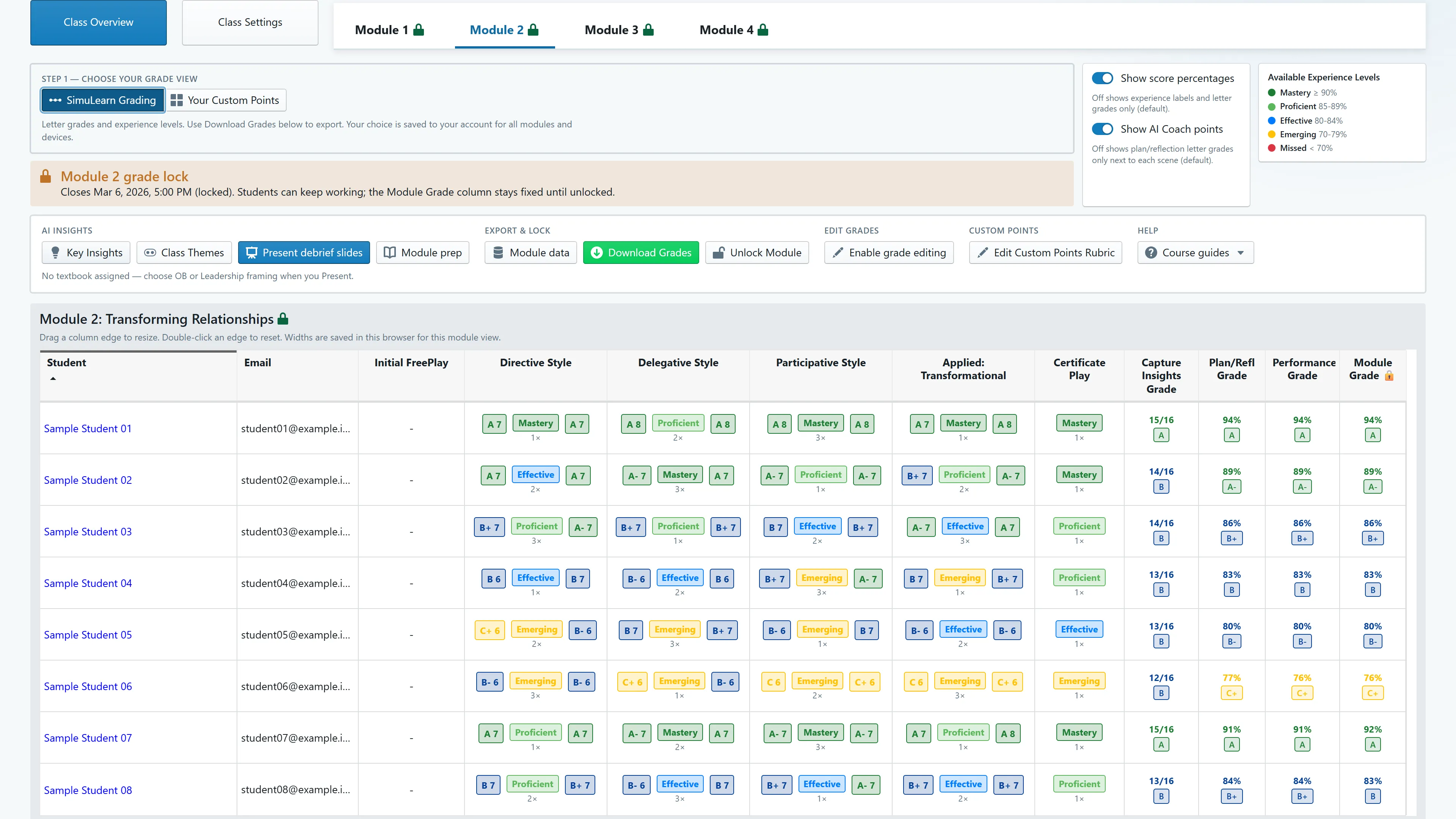
Four grade columns per module: Capture Insights, Plan/Refl, Performance, and the Module Grade they compose into — 40% plans and reflections, 40% simulation performance, 20% the end-of-module reflection.
Every plan and reflection is scored against named criteria with fixed point values — the same rubric the student reads and the document you can hand to a committee. Module grades compute from stated weights: 40% plans and reflections, 40% simulation performance, 20% end-of-module insights.
Click any grade cell, enter a new value and a reason. The reason is required — the server rejects the change without one — and the computed grade stays on the record underneath. Lock the module when you're done and the numbers stop moving, even if students keep playing.
One button builds a debrief deck from your class's own reflections — the themes they converged on, where they split, the strongest answers quoted without names. A separate prep briefing covers each module so you can run the debrief without having played the scenario yourself.
| Criterion | LLM-based roleplay tools | vLeader · symbolic AI |
|---|---|---|
| Engine | Large language model — probabilistic | Hand-coded causal rules — no model in the loop |
| Reproducibility | Different output for every student, every run | Same fixed rules for every student, every semester |
| Hallucination risk | Architectural — cannot be fully removed | None — there is no model to hallucinate |
| Gaming with AI | The student can generate the submission | Assessed on in-meeting behavior, which the student cannot generate |
| Scoring | Opaque; can't be shown to an accreditor | Rule-traceable; maps to stated learning outcomes |
| Assessment evidence | Chat logs | Comparable scores and graded reflection artifacts |
| Adoption | Enterprise contract / per-session pricing | Student-paid — adopt like a textbook |
// one of the few production-grade leadership simulations running in 2026 without a large language model in the loop
See the full comparison — vLeader vs Capsim, Mursion & ChatGPT roleplay →Every framework your students read about is also a rule the engine runs. Nothing is bolted on afterwards.
Directive, visionary, affiliative, democratic, pacesetting, coaching — surfaced as live choices under time pressure, where a quiz would only have asked about them.
Forming, storming, norming, performing — the group actually moves through them as the meeting unfolds, driven by what the student does.
Competing, collaborating, compromising, avoiding, accommodating — each produces a different, traceable outcome in the room.
Experience → reflect → conceptualize → experiment. The whole product is built on the loop you already teach.

Every score is generated by an explicit rule, and the same rule applies to every student in every cohort. That makes the results comparable enough to serve as a direct measure. It supplies evidence toward AACSB Assurance-of-Learning requirements — AACSB does not certify products, and we won't imply otherwise.
Adoption across five institutions, one peer-reviewed study, and our own outcome data — published with its limits attached.
2002
Virtual Leader ships on the KRY symbolic-AI engine, years before the LLM era. It has been kept symbolic by choice ever since.
2004
Training & Development Journal names it Best Online Training Product of the Year.
2011
Gurley & Wilson study the simulation in an MBA class at Fayetteville State University, an HBCU, in the Journal of Instructional Pedagogies.
2026
Same rule-based engine, now with published outcome data carrying its method and its limits. Generative AI sharpened the use case instead of threatening it.
Our own data · Summer 2026 · Graded reflections
Across a summer term of graded reflections, 62% scored higher after the debrief than before it, with improvement outnumbering decline better than two to one. It holds at the ceiling: 63% of students already scoring 9 out of 10 improved again. Regression to the mean would have moved that group the other way. This is a single-group before-and-after comparison with no control group. It shows scores move; it does not prove vLeader caused the movement against an alternative.
No simulation allows students to experience concepts such as emotional intelligence and conflict resolution like this one does.
"Each student tries things out on their own, multiple times, and gets great feedback."
"Better than role-playing — much less intimidating, and students actually engage."
Replaces a course-pack line. Nothing for IT to procure and no departmental budget request.
Lab Edition
Per student, per semester
Students purchase directly
Priced to take the place of a course pack instead of adding to one. Faculty get complimentary access to evaluate the full simulation first. If a student can't afford the fee, contact us — we've accommodated every hardship request to date.
vLeader is a leadership simulation used as courseware in MBA and Organizational Behavior courses: students lead a live business meeting with simulated colleagues, then complete a graded reflection and debrief. It runs on the KRY engine, whose causal rules are hand-coded; there is no language model in it. Published by SimuLearn Services, a division of OnCourse Inc; unrelated to VLeader Group, an HR services firm with a similar name.
It uses symbolic AI — explicit causal rules — rather than generative AI. The simulation engine contains no language model, so nothing in it can hallucinate: the rules are fixed and hand-coded, no model generates the consequence, and every score maps to a stated rule. Exact dialogue lines vary between runs; the causal logic does not. Reflections are graded by a rubric-driven model, which is disclosed separately because that part is generative.
ChatGPT produces conversation; vLeader produces consequences that follow the same fixed rules for every student and trace to a stated rule. Two practical differences for a course: a language model can give different, sometimes fabricated feedback to each student, so scores are not comparable across a cohort; and a student can generate a chat transcript. vLeader assesses behavior inside the meeting rather than text the student submits. The graded artifact is not something a student can generate.
Two kinds, and we publish the limits of both. Our own data: across a summer term of graded reflections, 62% scored higher after the debrief than before, with improvement outnumbering decline better than two to one. The effect holds at the top of the scale: 63% of students already scoring 9 out of 10 improved again. Regression to the mean would have pushed that group down. It is a single-group before-and-after comparison with no control group: it shows that scores move; it cannot show that vLeader caused the movement against an alternative. A model grades the rubric with no human rater involved, and the window is one term. Externally: Gurley and Wilson studied the simulation in an MBA class at Fayetteville State University, an HBCU, in the Journal of Instructional Pedagogies (2011).
Every run produces a gradeable reflection artifact and a rule-traceable score. Because every student faces the same scenario under the same fixed rules, the results are comparable. Comparable results can serve as a direct measure; chat logs cannot. It supplies evidence toward AoL requirements; AACSB does not certify or endorse third-party products, and no vendor can claim otherwise. We provide an alignment guide mapping rules to learning outcomes on request.
Close to none. We set the class up for you and email you the class code, a starter syllabus and the instructor kit; students enrol themselves by finding your class in the directory. It runs in any modern browser, with nothing to install and nothing for IT to configure.
It slots into a four-step rhythm built on Kolb's experiential cycle: self-paced simulation, graded reflection, classroom debrief, assessment. You keep your lecture; vLeader replaces role-play homework that does not scale.
Yes — and because the rules are fixed, the scenario runs under the same conditions each time: same setup, same colleagues, same causal logic, so the student tests a different approach against an unchanged situation.
Students purchase the Lab Edition directly, per semester — comparable to a course pack, and replacing rather than adding to a materials line. No departmental budget request, no per-seat license, no procurement cycle. Faculty get complimentary access to evaluate the full simulation. If a student cannot afford the fee, contact us; we have accommodated every hardship request to date.
Documentation for both is available: ask us for the data-handling and FERPA summary written for IT and procurement review. On assessment safety: the graded artifact is the student's conduct in the meeting, which a language model cannot produce on their behalf.
A 30-minute walkthrough with a sample assessment report and our outcome data, limits included. No sales pressure.
We respond within one business day.